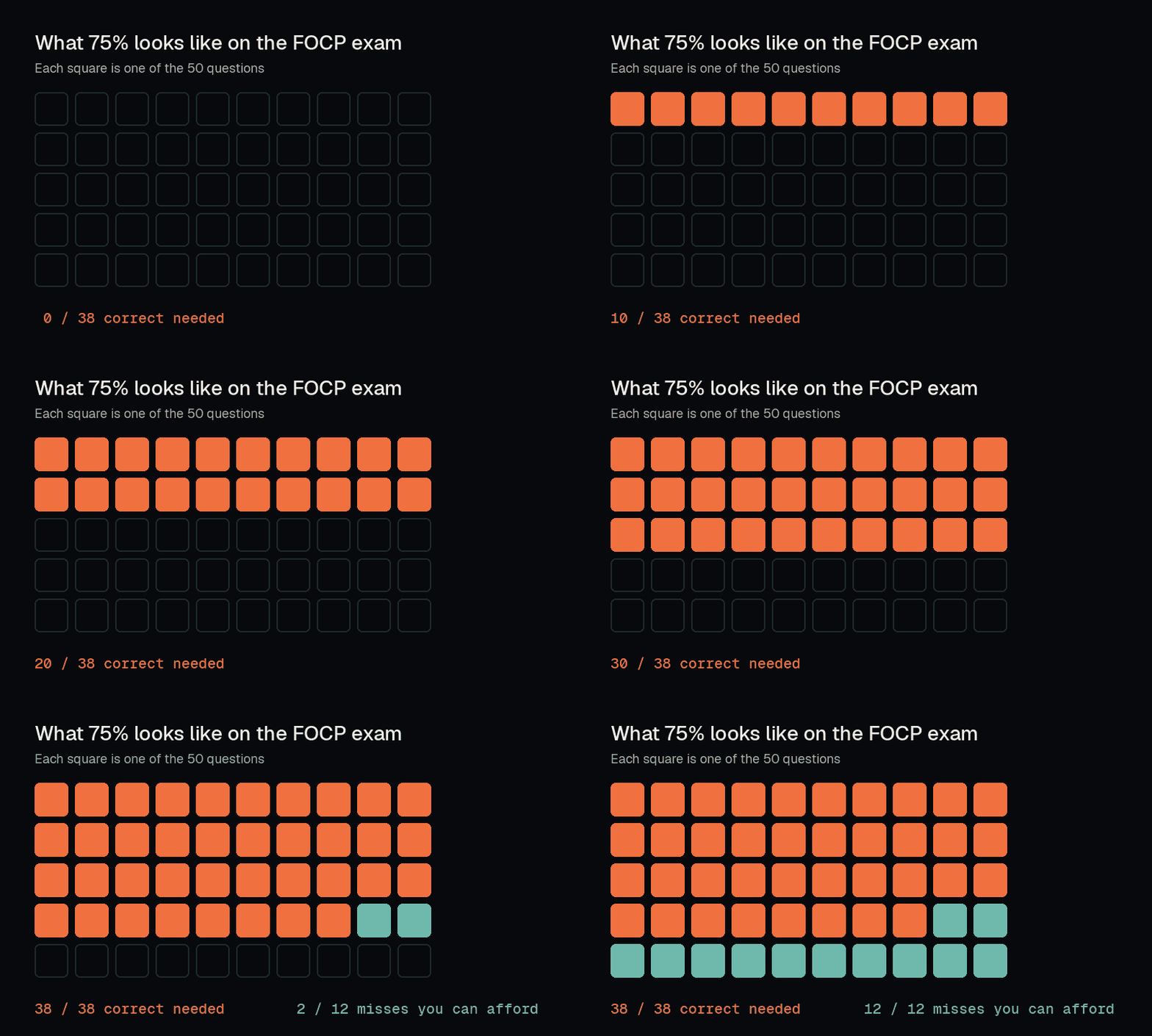
The FinOps Certified Practitioner (FOCP) exam is a 50-question, 60-minute multiple-choice test run by the FinOps Foundation. You need 75% to pass, which means 38 correct answers. You get three attempts within 12 months, the exam is not proctored, and the certification stays valid for 24 months.
That is the short answer. The rest of this guide covers what the exam actually tests, how its questions are framed, a three-week study plan, and the mistakes that most often cost candidates the pass mark.
FOCP exam at a glance
| Format | 50 multiple-choice questions |
| Time limit | 60 minutes |
| Pass mark | 75% (38 of 50) |
| Attempts | 3 attempts within 12 months of purchase |
| Proctoring | Not proctored, taken online |
| Validity | 24 months after you pass |
| Price | $325 exam only, or $500 with the official self-paced course |
Source: the official FOCP exam page on the FinOps Foundation's training site. Prices and rules can change, so check that page before you buy.
Who the FOCP certification is for
The FOCP is the entry-level FinOps certification. It is aimed at anyone who touches cloud spend without necessarily writing the infrastructure code: finance and FP&A analysts, procurement, product owners, IT managers, and engineers who are new to cost management. It proves you understand the shared language of FinOps, which is exactly why it is useful in cross-team roles.
If you design, tag and optimize infrastructure every day, look at the FinOps Certified Engineer track as well. Many people take the FOCP first because the Engineer content builds on the same Framework.
What the exam actually tests
The exam is built on the FinOps Framework, the open operating model maintained by the FinOps Foundation, a project of the Linux Foundation. You are not tested on AWS, Azure or Google Cloud commands. You are tested on whether you know which part of the Framework a situation belongs to, and what a mature practice would do about it.
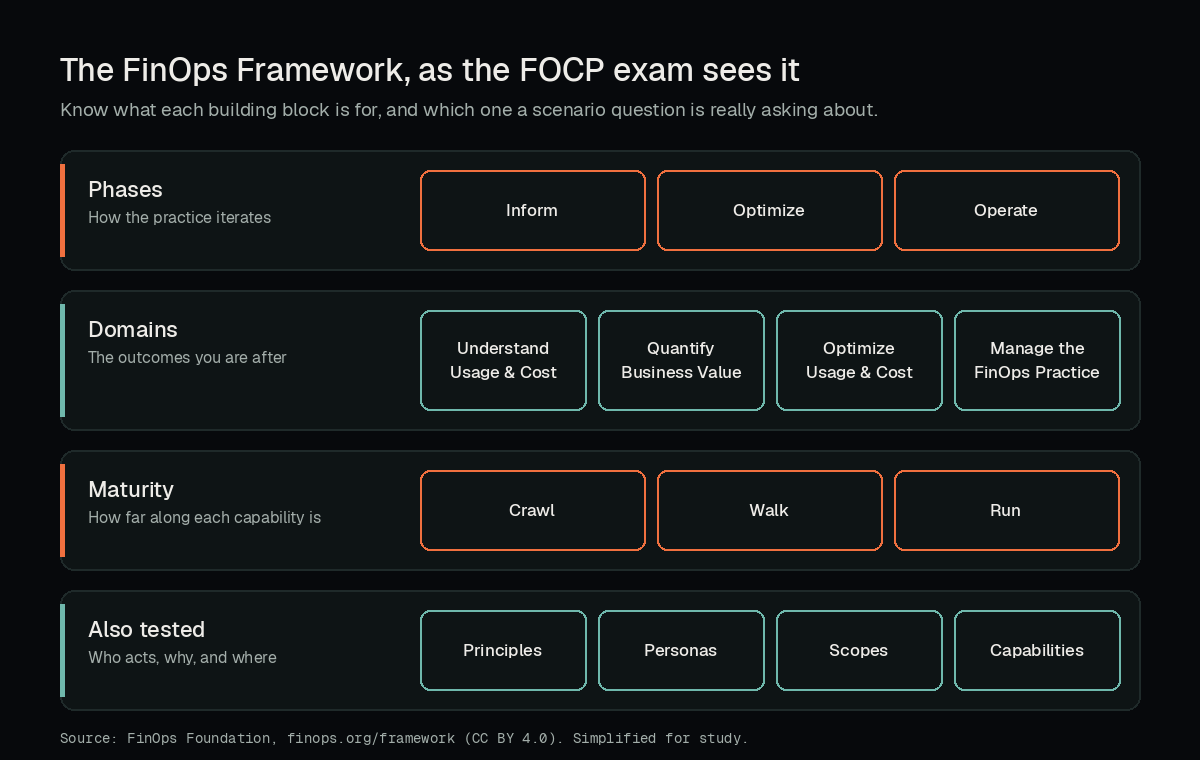
Here are the building blocks you need to know cold:
- Principles. The beliefs behind the practice, such as teams collaborating, everyone taking ownership of their usage, and decisions being driven by business value. Questions often describe a behaviour and ask which principle it reflects or breaks.
- Personas. Who does what: the FinOps practitioner, engineering, finance, leadership, product and procurement. Expect "who should own this?" questions.
- Phases. Inform (visibility and allocation), Optimize (reducing waste and improving rates), and Operate (making it continuous). The phases are a loop, not a one-time project.
- Domains. The four outcomes of a practice, as listed on finops.org: Understand Usage & Cost, Quantify Business Value, Optimize Usage & Cost, and Manage the FinOps Practice.
- Capabilities. The concrete activities inside each domain, such as allocation, forecasting, budgeting, anomaly management and rate optimization.
- Maturity. Crawl, Walk, Run. Maturity is measured per capability, so an organization can be at Run for allocation and still at Crawl for forecasting.
- Scopes. Where FinOps is applied. The Framework now extends beyond public cloud to areas such as SaaS, licensing and AI spend.
If any of these terms are new to you, start with our plain-language article What Is FinOps? before you go further.
How FOCP questions are framed
Most questions are short scenarios rather than definitions. They describe a team, a problem or a decision, then ask you to pick the best next step, the right persona, or the phase you are in. Two answers are usually plausible. The correct one is the one that matches the Framework's vocabulary and its collaborative, value-driven approach, not the one that would simply cut the most cost.
Here is an illustrative question in that style. It is written by us for practice and is not taken from the real exam:
A company has just started its FinOps practice. Engineering teams cannot see what their workloads cost, and finance receives one consolidated invoice each month. Which phase should the team focus on first?
A. Optimize, by buying commitment-based discounts
B. Inform, by allocating costs to teams
C. Operate, by automating budget alerts
D. Optimize, by rightsizing every instance
The answer is B. Without visibility and allocation, the team cannot know what to optimize or who should act. Buying commitments before you understand usage is a classic trap answer.
A three-week FOCP study plan
Most candidates with some cloud exposure are ready in 15 to 25 hours of focused study. That is our recommendation from teaching this material, not an official figure. Spread over three weeks, it looks like this:
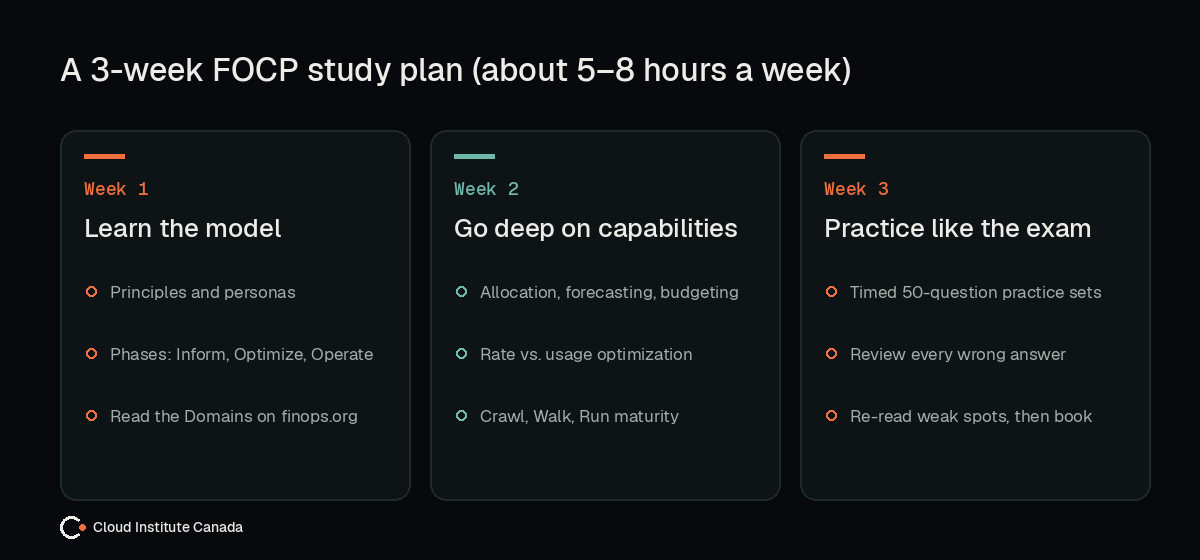
- Week 1, learn the model. Read the Principles, Personas and Phases pages on finops.org, then the four Domains. Write one sentence in your own words for each.
- Week 2, go deep on capabilities. Focus on allocation, forecasting, budgeting, anomaly management, and the difference between usage optimization (using less) and rate optimization (paying less for what you use). Learn what Crawl, Walk and Run look like for each.
- Week 3, practice like the exam. Do timed sets of 50 questions in 60 minutes. Review every wrong answer and name the Framework concept you missed. Book the exam when you score above 75% twice in a row.
Seven mistakes that cost candidates the pass mark
- Studying a cloud provider instead of the Framework. Knowing AWS Savings Plans in detail will not help if you cannot place them in the right domain and phase.
- Treating FinOps as cost cutting. The exam rewards answers about business value and collaboration, not the cheapest option.
- Confusing usage and rate optimization. Turning off idle resources reduces usage. Commitments and negotiated discounts reduce rates.
- Skipping personas. "Who should own this decision?" questions are easy points if you know the personas, and easy to lose if you guess.
- Assuming maturity is one level for the whole company. It is assessed per capability.
- Running out of time. You have about 72 seconds per question. Flag hard ones and come back.
- Relying on memorized dumps. Scenario wording changes. Understanding the model is the only reliable way to pass.
Official resources worth your time
- The FinOps Framework on finops.org, which is the primary source for every exam topic.
- The official FOCP self-paced course, about eight hours with the exam included.
- The FinOps Foundation training FAQs for rules on retakes, certificates and renewals.
- The O'Reilly book Cloud FinOps by J.R. Storment and Mike Fuller, for the background and real-world examples behind the Framework.
Frequently asked questions
How hard is the FinOps Certified Practitioner exam?
It is an entry-level exam, but the 75% pass mark leaves little room for guessing. Candidates who study the Framework itself, rather than a cloud provider's tools, usually pass on the first attempt.
Is the FOCP exam open book?
The exam is not proctored, but you only have about 72 seconds per question, so looking things up is not a realistic strategy. Prepare as if it were closed book.
How long is the FOCP certification valid?
24 months from the date you pass, according to the FinOps Foundation. A recertification option is available on the official training site.
Do I need technical cloud experience?
No. The exam tests FinOps concepts and vocabulary, not hands-on cloud skills. Some familiarity with how cloud billing works helps, but it is not required.
How much does the FOCP exam cost?
$325 for the exam only, or $500 for the official self-paced course with the exam included, as listed on learn.finops.org at the time of writing.