
What Is FinOps? A Plain-Language Guide for Cloud Teams
If you've heard the word "FinOps" and nodded along without fully knowing what it means, you're not alone. It's one of those terms that sounds important, gets dropped in meetings, and never quite gets defined properly.
Here's the plain-language version.
FinOps is a practice, not a tool
FinOps is short for cloud Financial Operations, is the discipline of managing cloud spending so that organizations get maximum value from every dollar they put into AWS, Azure, Google Cloud, or any other cloud provider.
It's not software you buy. It's not a one-time audit. It's an ongoing operational practice that brings together three teams who rarely talk to each other: engineering (who spin up the resources), finance (who get the bill), and business leadership (who approved the budget).
The FinOps Foundation, the industry body that defines and certifies the practice — puts it simply:
"FinOps is an operational framework and cultural practice which maximizes the business value of cloud."
Why does it matter?
Because cloud bills are notoriously hard to control.
Unlike traditional IT, where you buy a server and depreciate it over five years, cloud is pay-as-you-go. Every service you spin up, every database you leave running overnight, every development environment someone forgot to shut down it ,all appears on next month's invoice.
The average organization wastes 30% of its cloud spend on idle or oversized resources. That number comes from years of industry data, and it holds up across company sizes and cloud providers.
For a company spending $500,000 a year on cloud, that's $150,000 going nowhere.
Who does FinOps?
In a small company, it's often one engineer who cares about costs. In a larger organization, it becomes a dedicated FinOps team — or at minimum, a FinOps practitioner who bridges the gap between technical and financial stakeholders.
The FinOps Foundation offers a certification for practitioners: the FinOps Certified Practitioner (FOCP). It's the recognized credential for anyone doing this work professionally.
The three phases of FinOps
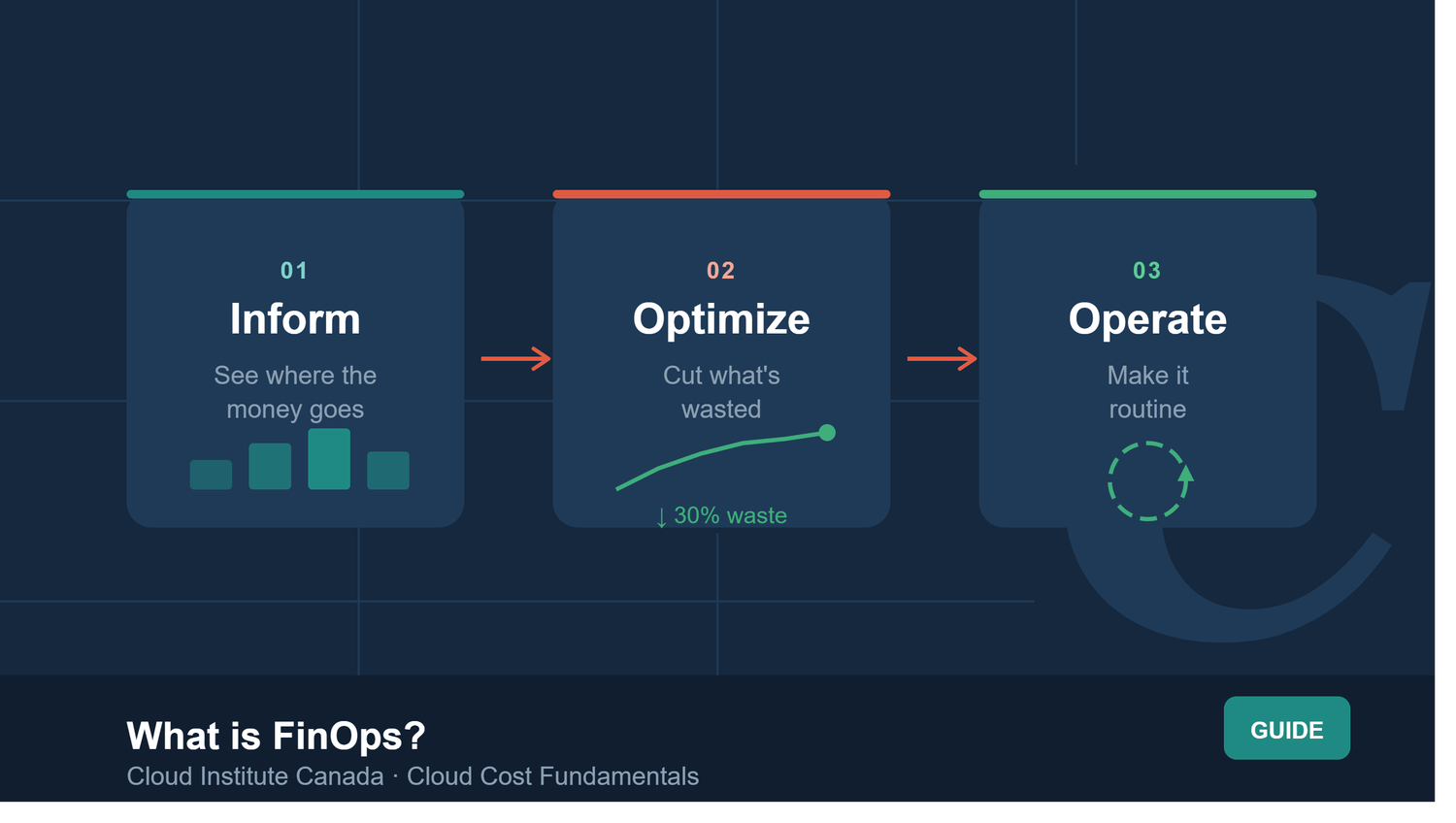
The FinOps Foundation describes the practice as a continuous lifecycle with three phases:
Inform: Get visibility. You can't optimize what you can't see. This phase is about understanding where your money is going, who's spending it, and what they're getting for it. Tools: cost allocation, tagging, dashboards, showback reports.
Optimize: Act on what you see. Once you have visibility, you start making changes: rightsizing oversized instances, buying reserved capacity instead of paying on-demand rates, eliminating idle resources. This is where the savings happen.
Operate: Make it stick. The biggest mistake organizations make is treating cost optimization as a project with a start and end date. FinOps is a loop, not a project. Operate means building the processes, automation, and culture that keep the loop running continuously.
FinOps isn't about cutting costs
This is the part that surprises people.
FinOps isn't about spending less. It's about spending wisely. If your company needs to triple its cloud spend to launch a new product, that's fine — as long as the business understands what it's buying and why.
The goal is informed decision-making. Engineering knows the cost impact of their architecture choices. Finance can predict cloud costs with reasonable accuracy. Leadership can evaluate cloud investments against business outcomes. That's FinOps working properly.
The three phases of FinOps
If you're new to FinOps, the best starting point is the FinOps Foundation's official framework, it's free and publicly available. If you want to get certified and prove your knowledge, the FinOps Certified Practitioner (FOCP) exam is the recognized credential.
Our Mastering FinOps (Practitioner) course covers the full FOCP curriculum in five animated, self-paced modules, built by certified practitioners who work with real cloud bills. Start the course for $99 →
Cloud Institute Canada


Ready to get certified?
One course, one payment, lifetime access, starting at $99.
©2026. All rights reserved.
Cloud Institute Canada